A Pulsafeeder pH probe for use with Pulsafeeder controllers.
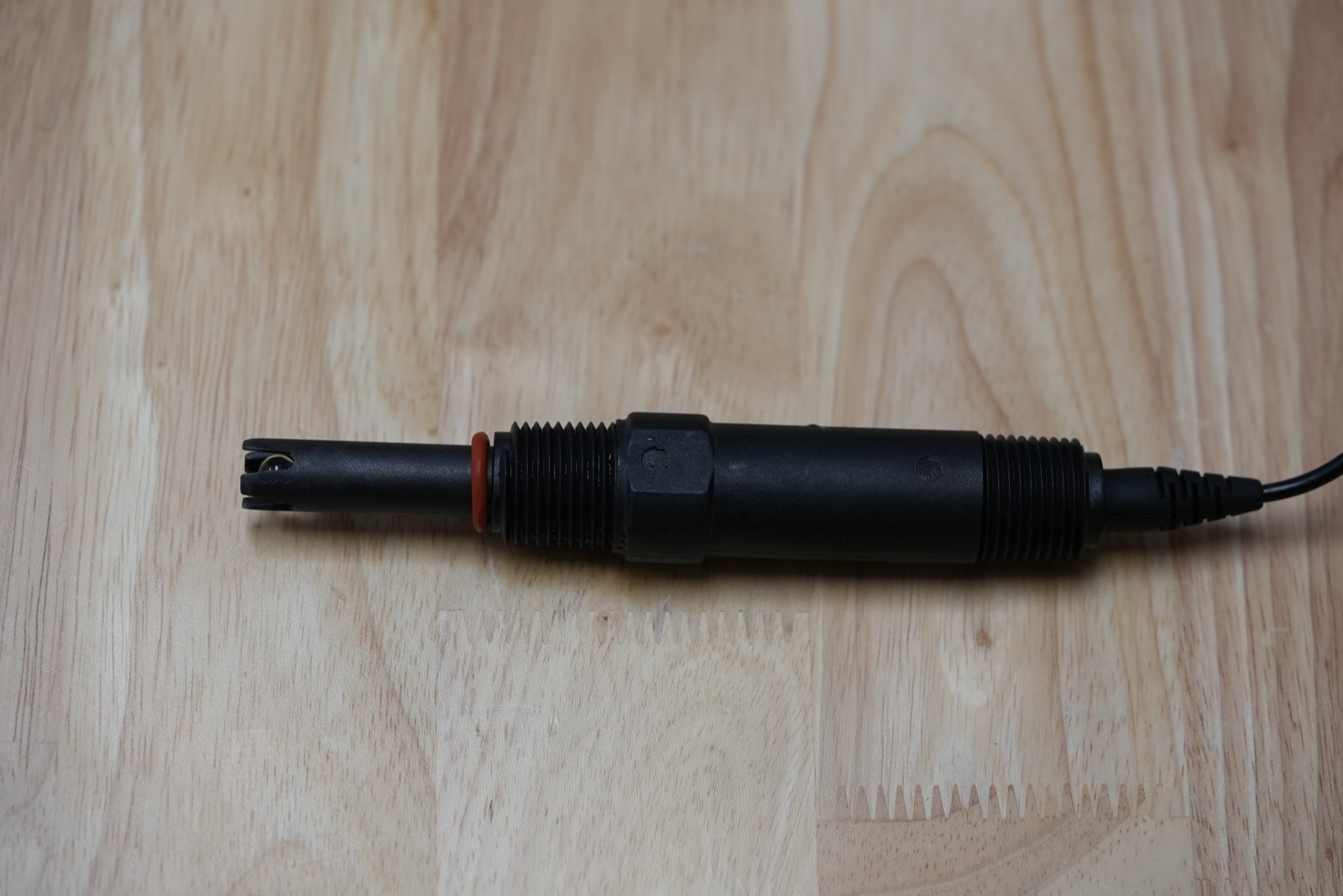
Some ratings are not filled in yet. Check the manufacturer’s current datasheet before wiring.
¶ What it measures
pH — see pH.
¶ Electrical interface
| Model | From datasheet — to be filled in |
| Output | Electrode signal to a MicroVision EX probe input; pH sensors are prewired to Probe 2 |
| Type | Combination pH electrode with a sealed, non-refillable reference |
| Controller reading range | 0.00–14.00 pH |
| Process connection | From datasheet — to be filled in |
| Pressure and temperature limits | 125 psi (8.6 bar), 50 °C (122 °F) maximum |
| Materials | Polypropylene |
| Flow | 1–5 GPM past the probe |
| Maximum cable length | 30.5 m (100 ft) |
The type, pressure, temperature, material, flow and cable figures are Pulsafeeder’s specification for the standard pH probe supplied with the MicroVision EX. Pulsafeeder supplies it already installed in a tee.
¶ Maintenance
Pulsafeeder’s MicroVision EX manual gives this care for the pH probe supplied with the controller.
- Before first use — remove the lower part of the protective boot and rinse the tip with tap water. Shake the probe downward, like a clinical thermometer, to clear air from the bulb. Before first use or after long storage, soak the tip in tap water for 30 minutes to hydrate the bulb.
- Storage — never let the probe dry out. Store it in pH 4.0 buffer with saturated KCl added, in its boot or bottle; tap water will do for a short time. Do not soak it in distilled water.
- Calibration — one point, from the MicroVision EX Probe Cal screen. Best practice is in-stream: with flow across the probe for at least 5 minutes, enter a hand-held meter reading taken at the sample valve, ideally within 1 pH of the set point. Or rinse the probe three times in a buffer on the same side of pH 7 as the set point, leave it in the buffer for 5 minutes, and enter the buffer value. Allow about 10 minutes for the probe to reach the sample temperature.
- Cleaning scale — immerse the tip in 0.1 M HCl, then 0.1 M NaOH, then 0.1 M HCl again, 5 minutes each.
- Cleaning oil or grease — wash the tip in liquid detergent and water, or in a solvent known to dissolve the film, then rinse in tap water.
- Clogged junction — soak the tip in dilute KCl solution heated to 60–80 °C (139–176 °F) for about 10 minutes, and let it cool in the solution before retesting. If the probe still responds poorly, replace it.
- Removal — always depressurise the piping before removing the probe.
Wear rubber gloves, eye protection and protective clothing when handling acids and caustics.
¶ Using it with a controller
Wiring and configuration live with each controller:
- MicroVision EX — see MicroVision EX. A setup guide is not written yet.