How ultrasonic sensors measure distance to a liquid surface by timing an echo, and what upsets them in a tank.
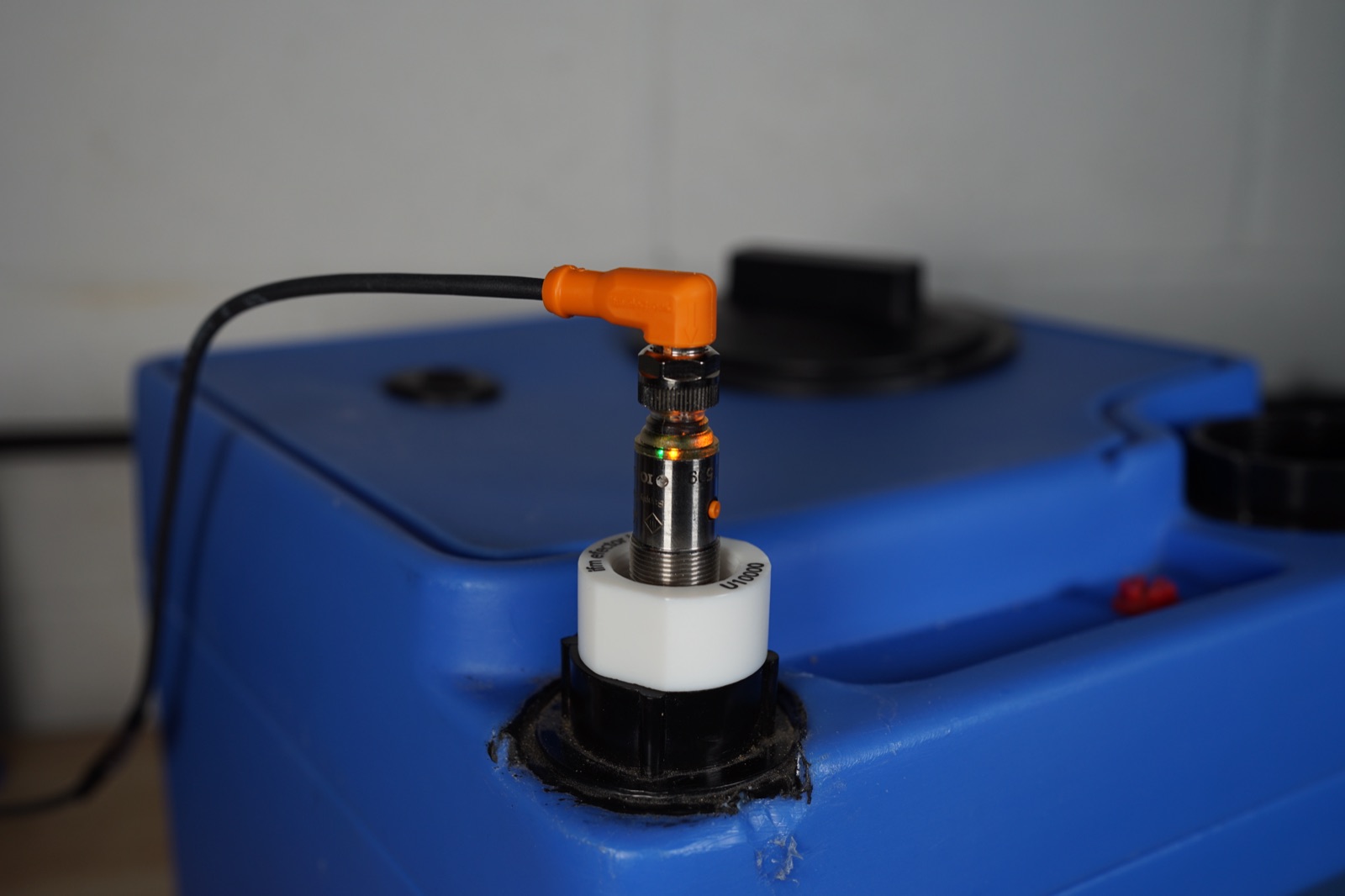
¶ How it works
An ultrasonic level sensor mounts in the top of a tank, looking down. It sends a short pulse of sound — above human hearing, from tens of kHz for long-range tank sensors to a few hundred kHz for short-range ones — and listens for the echo off the liquid surface.
- Time of flight. The sensor measures the time between sending the pulse and hearing the echo. Distance = speed of sound × time ÷ 2 (the sound travels down and back).
- Level from distance. The sensor or controller subtracts the measured distance from the distance to the tank bottom to give level, then converts level to volume using the tank’s shape.
- Speed of sound varies with temperature. In air it is about 343 m/s at 20 °C and changes by about 0.17 % per °C. Most sensors have a built-in temperature sensor and compensate, but it measures the temperature at the sensor, not throughout the tank. Strong temperature differences in the headspace still cause error.
- Beam angle. The sound spreads out in a cone, commonly a few degrees to about 10° either side of center depending on the sensor. Anything inside that cone can return an echo.
- Blind zone. The transducer is still ringing from sending the pulse for a moment afterwards, so it cannot hear echoes that come back too soon.
One thing that applies to every ultrasonic sensor: each has a near limit, or dead band, close to its face where it cannot measure. A surface closer than that gives a wrong or flagged reading, so the sensor must be mounted far enough above the highest liquid level.
¶ What interferes
- Foam absorbs sound. Light foam may give an unsteady echo; heavy foam can lose it entirely. Radar is often the better choice for foaming tanks.
- Vapour and fumes from chemicals change the speed of sound in the headspace, giving a steady error. Heavy vapours (for example from some acids or solvents) also absorb sound.
- Condensation and build-up on the sensor face weaken the pulse and the echo, and a droplet can cause false near-range echoes.
- Temperature gradients in the headspace, between the sensor and the surface, cause errors the built-in compensation cannot correct.
- Obstructions in the beam — ladders, pipes, mixers, heaters, welds, and the tank wall itself — give false echoes.
- Agitators and turbulent surfaces scatter the echo. The reading jumps or drops out while the agitator runs.
- Fill streams falling through the beam give false echoes and a disturbed surface.
- Pressure and gas composition in closed tanks change the speed of sound; ultrasonic sensors are generally for vented, atmospheric tanks.
- Narrow nozzles or standpipes reflect the sound and cause ringing close to the sensor.
¶ Installation
- Mount above the highest level plus the blind zone. The liquid must never rise into the near limit — allow some margin above the overflow level.
- Point straight down, perpendicular to the liquid surface. A few degrees of tilt can lose the echo.
- Keep the beam clear. Mount away from the tank wall by at least the manufacturer’s minimum distance (a common rule of thumb is roughly a sixth to a third of the tank diameter from the wall), not dead center on a domed top, which focuses echoes back, and away from ladders, pipes, and mixers. Check the beam cone against the tank depth: the cone widens as it goes down.
- Away from the fill stream and inlet, so falling liquid does not cross the beam.
- Nozzles. If the sensor sits in a nozzle or standpipe, keep it short and wide, with the transducer face projecting into the tank where the manufacturer allows. Follow the manufacturer’s maximum nozzle length for its diameter.
- Do not overtighten the sensor in its fitting; stress on the transducer affects the signal.
- Shield from direct sun outdoors to reduce temperature error at the sensor.
- Set the empty distance and span to the actual tank dimensions, and suppress fixed false echoes if the sensor supports it.
¶ Maintenance
- Keep the face clean. Wipe off condensation, crystals, or chemical build-up with a damp cloth and a cleaner compatible with the sensor face — see Material Compatibility.
- Check against a known level. Compare the reading with a dipstick, sight glass, or measured tape at two different levels. There is usually no routine calibration; errors normally come from set-up (tank height, offset) or obstructions.
- Recheck after changes to the tank — new pipework, a moved mixer, or a new fill point can add false echoes.
- Watch the signal quality if the sensor reports it; a falling echo strength points to build-up or foam before the reading fails.
Chemical tanks can give off hazardous vapour when the sensor fitting is opened. Follow Chemical Handling and wear eye protection when working on a tank top.
¶ Equipment
Models documented in this wiki: