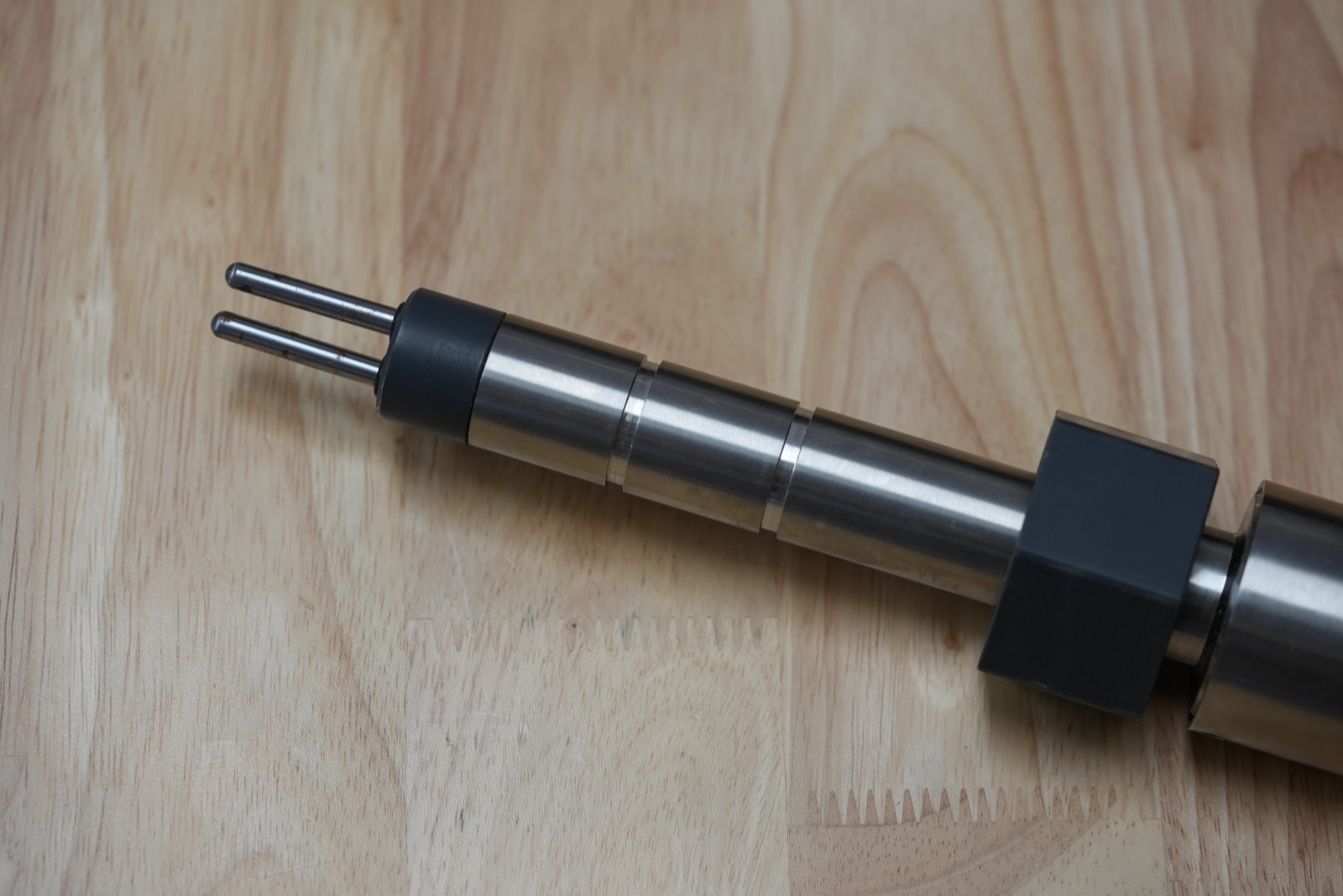
A Pyxis Labs corrosion rate probe for cooling and process water.
¶ What it measures
Corrosion rate — see Corrosion Rate.
The CR-300 (P/N 51007) uses linear polarization resistance (LPR) between two test-metal electrodes to give the general corrosion rate in mils per year (MPY). Between LPR readings it measures electrochemical noise and reports it as a localized (pitting) corrosion index. It measures the water’s conductivity through the same electrodes and compensates for it.
| General corrosion range | 0.001–10.000 MPY by default (set by the metal chosen in uPyxis); up to 995 MPY with a custom scale |
| Localized corrosion range | 0.001–100 index |
| Resolution | 0.001 MPY |
| Conductivity compensation | 10–10,000 µS/cm |
| Alloy factor | 0–3, set from the metal’s UNS code in uPyxis |
| Reading interval | 3–1,440 minutes (over 3 minutes needed for localized corrosion data) |
¶ Electrical interface
| Output | Two 4–20 mA outputs (general and localized corrosion) and RS-485 Modbus RTU |
| 4–20 mA default scaling | Mild steel: 4 mA = 0; 20 mA = 10 MPY (general) and 100 index (localized). Other metals have their own defaults in uPyxis |
| Wireless | Bluetooth, through the MA-CR adapter supplied with the probe, or a Pyxis PowerPACK |
| Supply | 24 VDC, 2 W; size a separate supply for 22–26 VDC at 65 mA |
| Connector and cable | 8-pin quick connector; 1.5 m (5 ft) extension cable and a 2 ft flying-lead cable supplied |
| Electrodes | Two 5 cm² (0.736 in²) test-metal electrodes on 4-40 threaded rods; one mild steel pair (P/N 51002) and one copper pair (P/N 51003) supplied |
| Wetted materials | 304 stainless steel body, test-metal electrodes, O-rings |
| Process connection | 1 in NPT tee; a compression nut locks the probe at one of three insertion depths |
| Pressure and temperature limits | Up to 7 bar (100 psi); sample −20–50 °C; working −10–50 °C, storage −20–70 °C |
| Ingress rating | IP65 |
Wire colors:
| Wire | Function |
|---|---|
| Red | 24 V + |
| Brown | 24 V power ground |
| White | General corrosion rate, 4–20 mA + |
| Pink | Localized corrosion rate, 4–20 mA + |
| Gray | 4–20 mA − (internally connected to power ground) |
| Blue | RS-485 A |
| Yellow | RS-485 B |
| Green | Shield, earth ground |
The 4–20 mA − and the 24 V ground are joined inside the probe. On a controller with a non-isolated 4–20 mA input, you do not need to land the gray wire. Pyxis’s wiring for Advantage Controls MegaTron controllers adds a jumper from the − terminal of the input that reads the pitting signal to the −24 V terminal.
Pyxis does not publish the CR-300’s Modbus register map or serial settings; it supplies them on request from service@pyxis-lab.com. The registers the InteliHive uses are listed on the Modbus Register Map. The Modbus address can be changed in the uPyxis desktop app.
¶ Maintenance
- Installing electrodes — the probe ships without electrodes. Put an O-ring on each threaded rod, screw the electrodes on until they slightly compress the O-rings, and clean them with isopropanol to remove oil.
- Orientation — keep both electrodes fully immersed, parallel to the flow, and away from turbulence.
- Setup — the probe ships set for mild steel. For another metal, pick it in the uPyxis app (through the MA-CR adapter) and apply its alloy factor and 4–20 mA scales, then set the same scales in the controller.
- Verification — the probe comes with 2.0 MPY and 0.1 MPY calibration check caps. With fresh electrodes and the uPyxis default settings, plug in a cap, wait at least 15 minutes (three readings), and check that the controller shows the value marked on the cap.
- Electrodes — replace severely corroded electrodes. Light corrosion product on the electrode surface is fine, but remove scale such as calcium carbonate and clear any deposit from the probe body and the electrode bases.
- Stagnant water — do not leave the probe in stagnant water for long, unless measuring corrosion in stagnant conditions is the aim.
Pyxis does not make the electrodes; it resells them from Metal Samples. Electrodes of another length or diameter work if they have a 4-40 internal thread, but if their area is not 5 cm² the alloy factor must be recalculated in proportion to the area.
¶ Using it with a controller
Wiring and configuration live with each controller:
- InteliHive (upcoming firmware) — over Modbus RTU, default address 23. The controller reads general and localized corrosion, sets the probe’s metal, and runs the check-cap calibration. See Modbus Probes — CR-300 and Calibration.
- MicroVision EX — no dedicated setup. The optional 4–20 mA input card (UGK-MILIN, up to two inputs) accepts the CR-300’s 4–20 mA outputs as generic inputs; use two inputs to read both general and localized corrosion. See MicroVision EX.
¶ Sources
- Pyxis Lab: CR Series corrosion rate sensors user manual, rev. 1.57 (PDF)
- Pyxis Lab: CR-200 and CR-300 data sheet (PDF)
- Pulsafeeder: MicroVision EX installation and operation manual, rev. G (PDF)