Runs an output when a sensor reading crosses a target value, and stops it once the reading has recovered by a set margin. Use it wherever you can measure the thing you are controlling — conductivity, ORP, pH.
¶ Settings
| Setting | What it does |
|---|---|
| Setpoint | The reading at which the output turns on. |
| Differential | How far the reading must recover past the setpoint before the output turns off. |
| Direction | Rising — turn on as the reading climbs to the setpoint. Falling — turn on as it drops to the setpoint. |
The input must be a measured reading — pH, conductivity, ORP, pressure, flow rate. Switches, running totals, and tank level are not offered: switches and level belong on the interlock list, and a running total only ever climbs.
The setpoint and differential ranges follow the units of the sensor you selected, so a pH probe offers pH values and a conductivity probe offers µS/cm. Each unit also has a minimum differential, which stops the output chattering on and off around the setpoint.
¶ How it decides
| Direction | Output turns on when the reading is… | Output turns off when the reading is… |
|---|---|---|
| Rising | at or above the setpoint | at or below setpoint − differential |
| Falling | at or below the setpoint | at or above setpoint + differential |
Between those two points the output stays as it is. That gap is what keeps a reading hovering near the setpoint from switching the output every half second.
Example — conductivity bleed (Rising). Setpoint 2500 µS/cm, differential 50. The bleed valve opens when conductivity reaches 2500 and closes once it has fallen to 2450.
Example — ORP feed (Falling). Setpoint 650 mV, differential 20. The oxidizer pump starts when ORP drops to 650 and stops once it has recovered to 670.
Example — PTSA inhibitor feed (Falling). Setpoint 100 ppb, differential 10 — the starting values for a Pyxis ST-500. The inhibitor pump starts when PTSA drops to 100 ppb and stops once it has recovered to 110.
¶ Worked example: a bleed setpoint from cycles of concentration
The make-up water reads 600 µS/cm, and the water treater wants the tower at 4 cycles.
- Setpoint = make-up conductivity × cycles = 600 × 4 = 2,400 µS/cm, Rising.
- Differential: about 2 % of the setpoint is a sensible start — 50 µS/cm. The valve opens at 2,400 and closes at 2,350.
- Check the result a week later. Divide the tower’s conductivity by the make-up’s, from a lab sample of each. If the make-up has changed — a new well, a seasonal swing — the same setpoint now means different cycles, and the setpoint needs moving.
A wider differential means fewer, longer bleeds and a bigger swing in the tower’s conductivity; a narrower one the reverse. See Cycles of Concentration for the water balance behind this.
Choose the direction from what the output does to the reading. A bleed valve and an acid pump both lower their reading, so they turn on as it rises — Rising. An oxidizer or caustic pump raises its reading — Falling.
¶ Sampling
Sampling decides how the sensor is read. It matters when the probe only sees representative water while a valve is open — typically boiler blowdown, where the probe sits on the blowdown line.
| Sampling | How it reads | Use when |
|---|---|---|
| Continuous | Every tick | The probe sees representative flow all the time. The usual choice. |
| Timed Sample | Opens the valve periodically, flushes, then reads while flowing | The probe sits on a line that is normally closed |
| Sample & Hold | Flushes, closes the valve, lets the sample settle, then reads | The flowing reading is unreliable — for example, boiler water flashing to steam |
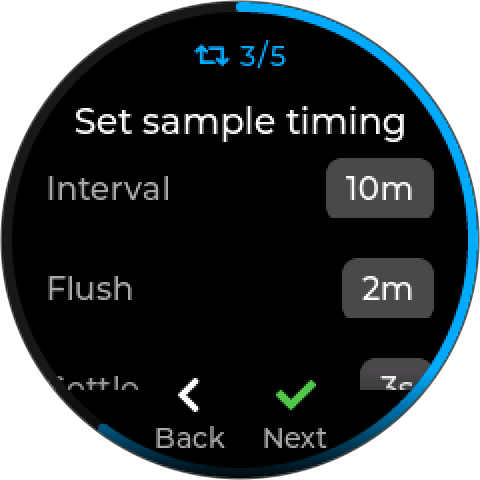
For Timed Sample and Sample & Hold, the Set sample timing step sets the intervals.
Timed Sample and Sample & Hold in detail
Timed Sample. Every Interval, the valve opens for the Flush time to flush fresh water past the probe. Readings taken in the first Settle seconds are ignored. If the reading is still beyond the setpoint at the end of the flush, the valve stays open until it clears the differential.
Sample & Hold. As Timed Sample, then the valve closes for the Hold time so the trapped sample settles, and the reading taken at the end of the hold decides. If it is still beyond the setpoint, the valve opens for one Pulse, closes, and measures again — repeating until the settled reading clears the differential. The last settled reading is held between samples.
Starting values offered by the wizard, for any setting the mode does not already have:
| Setting | Boiler profile | Other profiles | Applies to |
|---|---|---|---|
| Interval | 10 min | 1 min | Both |
| Flush | 2 min | 30 s | Both |
| Settle | 3 s | 3 s | Both — must be shorter than Flush |
| Hold | 90 s | 30 s | Sample & Hold |
| Pulse | 30 s | 30 s | Sample & Hold |
| Limit alarm | 1 h | Off | Both |
The Boiler values are the boiler blowdown defaults, which setup also gives the first blowdown loop. On other profiles the controller starts from 30 s, 8 s, 3 s, 10 s and 5 s, and raises any value below the shortest its screen offers — 1 min for Interval, 30 s for Flush, Hold and Pulse. See Factory Defaults.
Limit alarm. Optional. If a single blowdown cycle stays open longer than this, the controller raises Actuation Limit (212). The alarm does not close the valve.
¶ Run-time limits
Three further limits can bound how long the output runs. They are not shown on the controller’s screen: the boiler blowdown setup sets them, and editing a mode on the controller keeps whatever values it already has.
| Limit | What it does |
|---|---|
| Minimum on time | Once on, the output stays on at least this long, whatever the reading. Stops short pulses on a bouncing reading. |
| Maximum on time | The output is forced off after this long, whatever the reading. A safety cap on a single event. |
| Re-entry gap | After turning off, the output stays off at least this long before it can turn on again. |
A Sample & Hold Pulse cannot be longer than the maximum on time.
¶ When the sensor stops reading
The output is not driven on a stale or missing value. If the sensor stops responding, the mode stops and its output goes to its safe state — see What every mode does.
¶ Related
- Cooling towers — Cycles of Concentration — conductivity bleed
- Boilers — Sampling and Blowdown Control — boiler blowdown on TDS
- Control Modes — choosing a mode, interlocks
- Calendar — temporarily raise a setpoint on a schedule
- Supported Devices
- Error codes