The InteliHive is a dosing and monitoring controller for water treatment systems. It reads sensors, decides what needs to happen, and drives pumps, valves, and outlets — continuously and unattended.
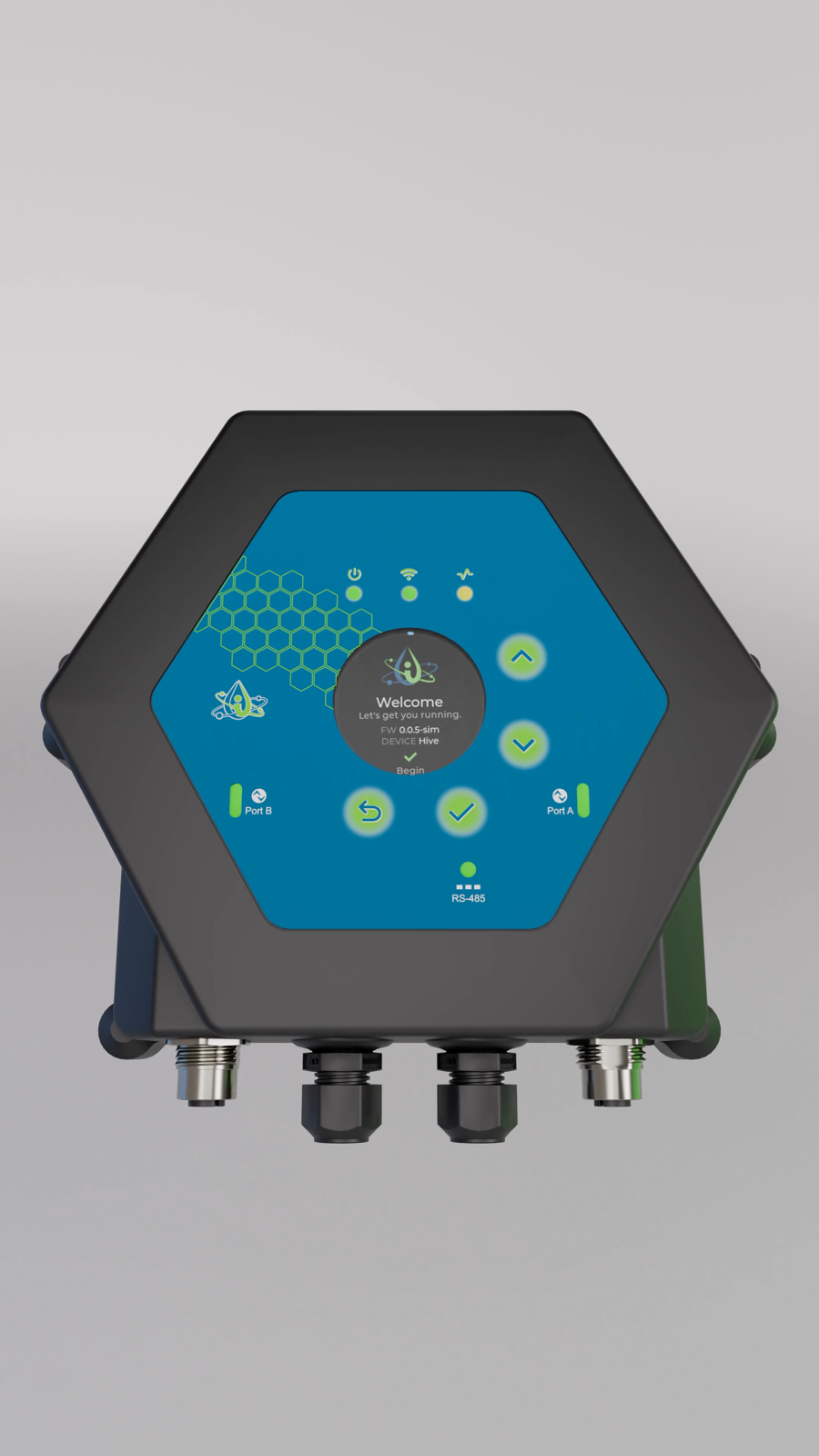
New to the controller? Start with What Is The InteliHive, then work through Getting Started in order.
¶ How it works
Everything the controller does follows the same three-part path.
Devices in. Anything the controller reads from or switches is a device — a pH probe, a level sensor, a dosing pump. Devices connect three ways: Modbus RTU for water-quality probes, IO-Link for smart digital sensors, and wireless for mains-powered equipment that is awkward to cable. Each device reports channels — one reading or one switch apiece.
Control modes decide. A control mode is a rule that decides when an output runs: when a reading crosses a setpoint, for a share of every cycle with a percent timer, in proportion to metered volume, or on a calendar schedule. Modes reference channels by name, so one sensor can drive several loops.
Actuators out, with a safety net underneath. When a device stops responding the controller raises an error and drives dependent loops to their safe state rather than acting on a stale reading.
¶ Contents
¶ Getting Started
Installing a controller and bringing it up for the first time.
- What Is The InteliHive — what the controller does and where it fits
- What’s in the Box — unpacking and parts
- Mounting — where and how to fix the enclosure
- Wiring — power, sensors, actuators, and buses
- Starting Up Your Controller — first power-up
- Your First Ten Minutes — the buttons and screens, by setting the clock
- What the LEDs Mean — reading the front panel
¶ Devices
Everything the controller reads from or switches.
- Devices — the three kinds and how to choose
- Supported Devices — what works, and from which firmware
- Modbus RTU Devices — wired water-quality probes
- Modbus Probes — each Pyxis probe’s page, cleanliness, metal, tank, and label
- IO-Link Devices — smart digital sensors, one per port
- Wireless Devices — mains-powered switches and outlets
¶ Control Modes
How the controller decides what to do with a reading.
- Control Modes — choosing a mode, interlocks
- Setpoint Control — a reading drives the output
- Percent Timer — on for a share of every cycle
- Volume Dosing — feed proportional to metered water
- Calendar — scheduled programs (field testing)
- Interlocks — conditions that stop a mode running
- Safety Trips and Rate Limits — trips on a reading, limits on an output
¶ Operating
Day-to-day use of a running controller.
- Alarms — reading and acknowledging alarms
- Hand, Off, Auto — running outputs by hand, and holding them off
- Calibration — Sensorex and Pyxis probes
- Reading Limits — alarm limits on a reading
- Network and Cloud — WiFi and Inteliverse
- Firmware Updates
- Settings — every item in the Settings menu
¶ Error Codes
Every alarm the controller raises has a numeric code.
- Error Codes — how codes are numbered and grouped
- 100 — Device Disconnected
- 600 — Power Fault
¶ Reference
Numbers, diagrams, and register maps.
¶ Field Tools
Printable sheets for site work.
¶ Safety
Read before installing, wiring, or servicing a controller.
¶ Troubleshooting
Symptom-first: power, outputs, readings, devices, network, and schedules — each pointing to the fix.